
If you have been following the rapid advancements in robotics and artificial intelligence, you have likely heard the term Embodied AI. Unlike traditional AI that lives entirely on servers (like chatbots or image generators), Embodied AI interacts with the physical world. But to teach a humanoid robot how to cook, sort warehouse packages, or assemble machinery, we must first teach it how to see and act like a human.
This is where Egocentric Video Data comes into play. In this guide, we will explore what egocentric data is, why it is the missing puzzle piece for Embodied AI, how to collect it, and the ultimate hardware solution to streamline your workflow.
What is Egocentric Video Data?
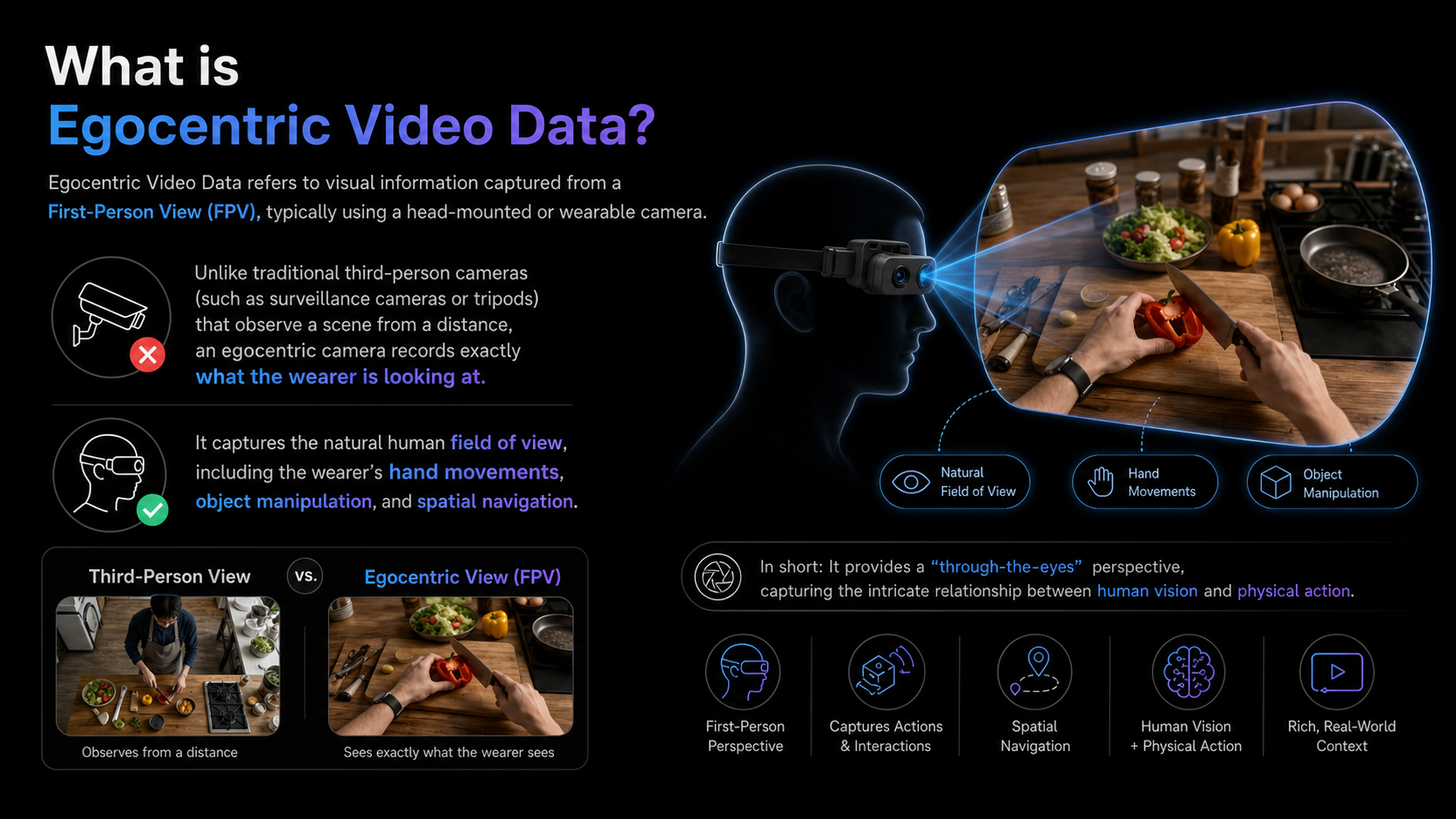
Egocentric Video Data refers to visual information captured from a First-Person View (FPV), typically using a head-mounted or wearable camera.
Unlike traditional third-person cameras (such as surveillance cameras or tripods) that observe a scene from a distance, an egocentric camera records exactly what the wearer is looking at. It captures the natural human field of view, including the wearer’s hand movements, object manipulation, and spatial navigation.
In short: It provides a “through-the-eyes” perspective, capturing the intricate relationship between human vision and physical action.
How Does Egocentric Video Data Empower Embodied AI?
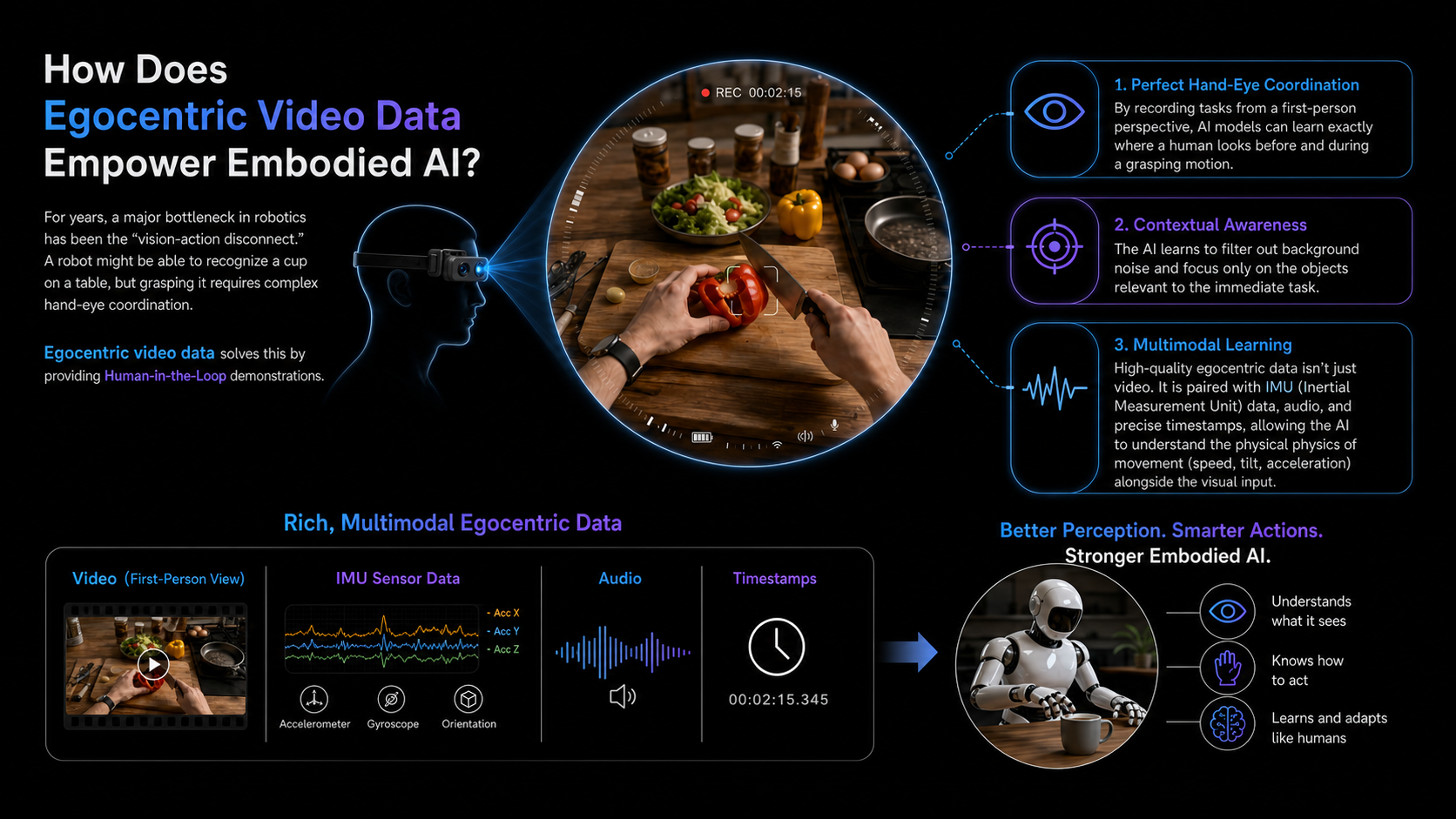
For years, a major bottleneck in robotics has been the “vision-action disconnect.” A robot might be able to recognize a cup on a table, but grasping it requires complex hand-eye coordination.
Egocentric video data solves this by providing Human-in-the-Loop demonstrations. Here is how it empowers Embodied AI:
- Perfect Hand-Eye Coordination: By recording tasks from a first-person perspective, AI models can learn exactly where a human looks before and during a grasping motion.
- Contextual Awareness: The AI learns to filter out background noise and focus only on the objects relevant to the immediate task.
- Multimodal Learning: High-quality egocentric data isn’t just video. It is paired with IMU (Inertial Measurement Unit) data, audio, and precise timestamps, allowing the AI to understand the physical physics of movement (speed, tilt, acceleration) alongside the visual input.
How to Acquire Egocentric Video Data?
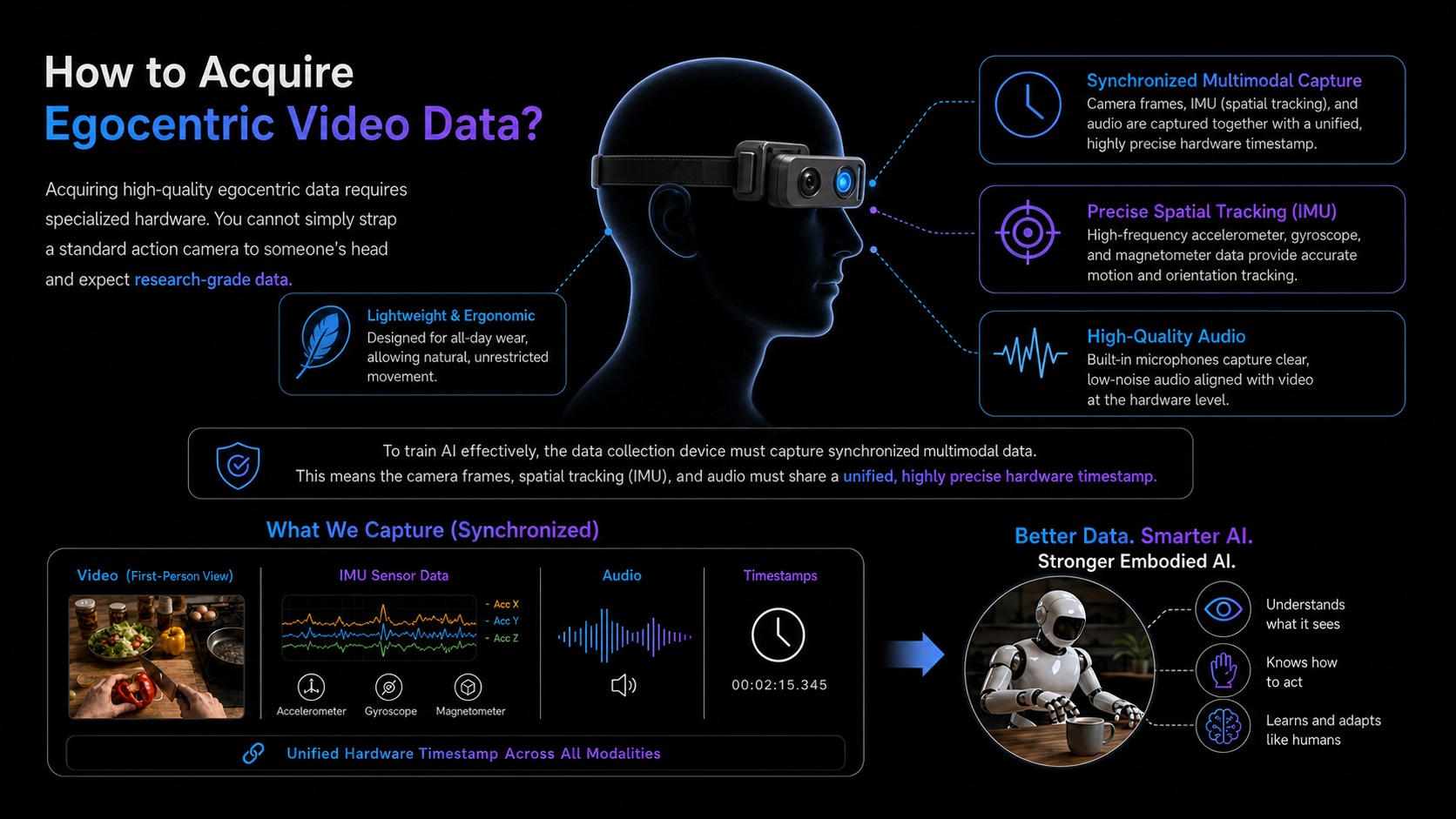
Acquiring high-quality egocentric data requires specialized hardware. You cannot simply strap a standard action camera to someone’s head and expect research-grade data.
To train AI effectively, the data collection device must capture synchronized multimodal data. This means the camera frames, spatial tracking (IMU), and audio must share a unified, highly precise hardware timestamp. Furthermore, the device must be lightweight so that the human operator can perform tasks naturally without physical restriction.
The Egocentric Data Collection Workflow
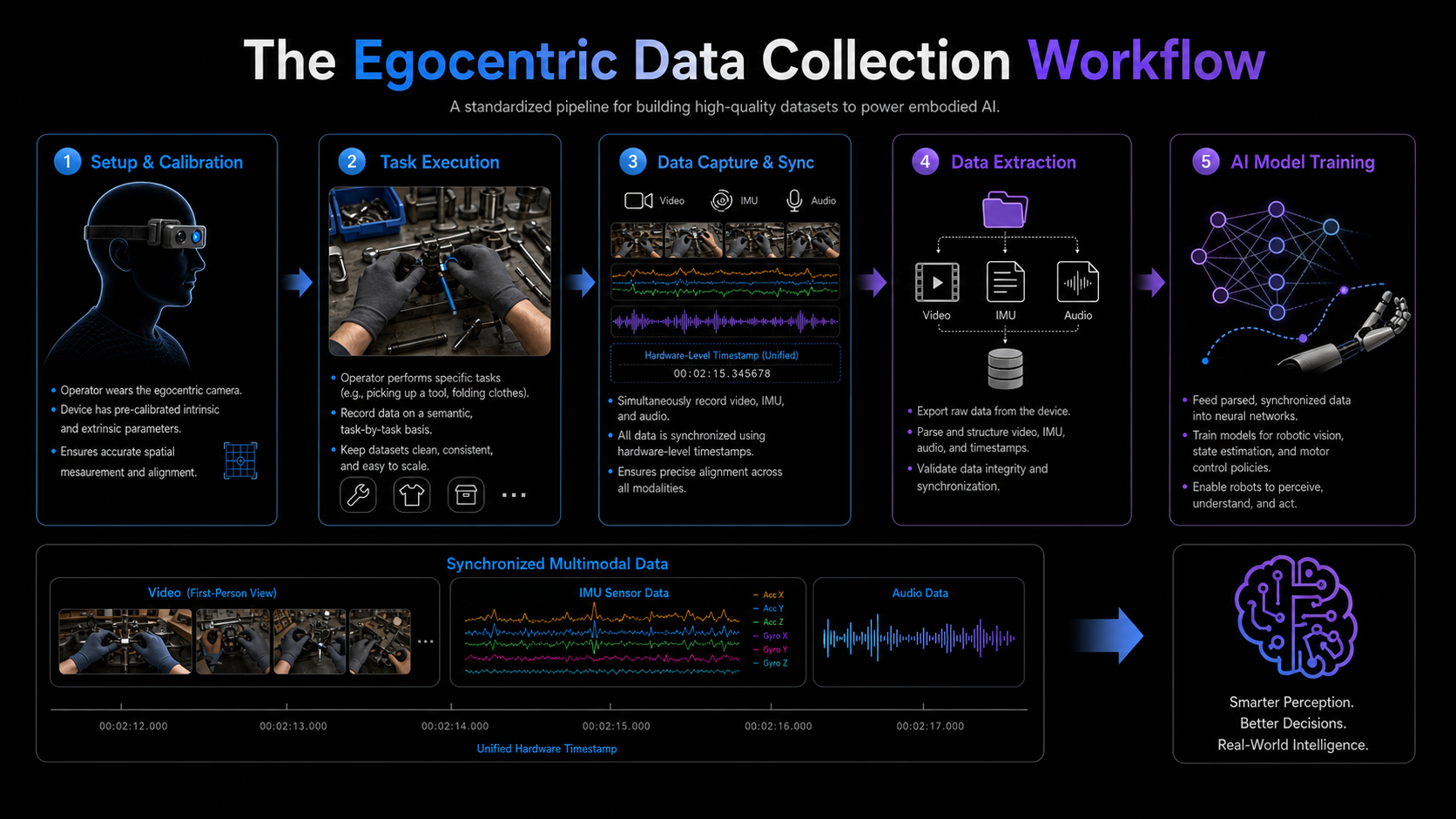
Building a clean data pipeline is crucial for machine learning. A standard egocentric data collection workflow looks like this:
- Setup & Calibration: The operator wears the egocentric camera. The device must have pre-calibrated intrinsic and extrinsic parameters for accurate spatial calculation.
- Task Execution: The operator performs specific tasks (e.g., picking up a tool, folding clothes). Data should be recorded on a semantic, task-by-task basis to keep datasets clean.
- Data Capture & Sync: The device simultaneously records video, IMU, and audio, syncing them with hardware-level timestamps.
- Data Extraction: The raw data is exported and parsed.
- AI Model Training: The parsed, synchronized data is fed into neural networks to train robotic vision and motor control policies.
Introducing VDEgo by Virdyn: The Ultimate Egocentric Data Solution
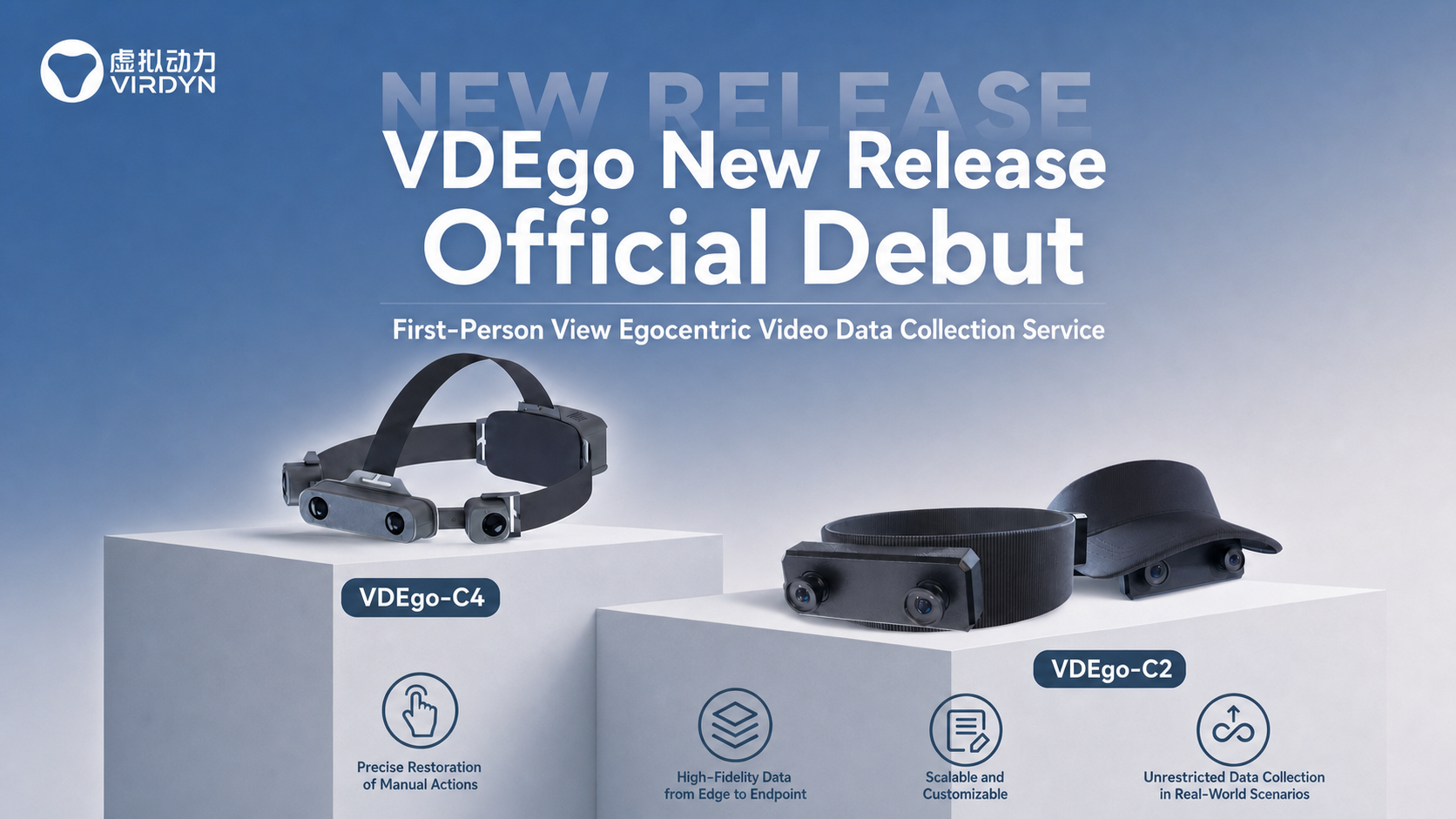
If you are looking to build a robust data pipeline for your Embodied AI projects, Virdyn has officially launched the perfect hardware solution: VDEgo.
VDEgo is a professional-grade Egocentric Video Data Collection Device designed specifically to solve the vision-action disconnect. Available in two versions—the binocular VDEgo-C2 and the quad-camera VDEgo-C4—it is built to handle the rigorous demands of AI research.
Why Choose VDEgo?
- Rich Multimodal Data Output: VDEgo doesn’t just record video. It outputs a custom compressed package containing high-quality Color Video (MP4/H.265), high-frequency IMU data, audio, hardware-level timestamps, and built-in calibration parameters. Virdyn even provides a dedicated Decompression API for developers to easily parse the data.
- Flexible Dual-Mode Collection:Lightweight & Wearable: Designed for zero-restriction movement, making it perfect for industrial assembly, warehouse sorting, and domestic service robot training.
- On-Device Control: Simply press a physical button on the headset to start/stop recording, with support for simultaneous real-time uploading to your designated server.
- Wireless Web Control: Connect your PC or smartphone via Wi-Fi to access a built-in web dashboard. You can remotely control recording, view live previews, manage downloads, and monitor upload progress—no app installation required!
Ready to Upgrade Your AI Training Data?
High-quality data is the fuel for the next generation of robotics. With VDEgo, capturing professional, synchronized egocentric data has never been easier.
Post time: Jun-05-2026