
As the fields of Embodied AI, humanoid robotics, and spatial computing accelerate, the demand for high-quality, real-world training data has skyrocketed. However, researchers and engineers are quickly realizing that traditional, third-person video datasets are no longer sufficient. To teach a machine how to interact with the world like a human, it needs to see and move like a human.
This realization has sparked a massive shift toward Egocentric (First-Person) Video Data Collection. Today, we are exploring the market trends driving this shift, the immense power of combining ego-vision with IMU sensors, and how Virdyn’s new release, the VDEgo, is revolutionizing data collection at scale.
The Market Trend: Why Egocentric Vision is the Future
Historically, AI models were trained on data captured from static cameras or third-person viewpoints. While useful for observation, this data lacks the crucial “operator’s perspective.”
The current market trend is heavily pivoting toward first-person data. Why? Because to train a robotic arm to assemble a motor, or a humanoid robot to fold laundry, the AI must understand the exact visual cues the human operator saw at the precise moment they executed a physical action. Egocentric data provides this intimate, action-oriented viewpoint, making it the gold standard for training next-generation robotic systems.
The Advantage of Combining Ego Vision with IMU Sensors
While first-person video is highly valuable, video alone only tells half the story. The true breakthrough happens when you combine Egocentric Vision with Inertial Measurement Unit (IMU) sensors.
Traditional data collection often suffers from a “vision-action disconnect”—the visual data doesn’t perfectly align with the physical movement data. By integrating high-frequency IMU sensors directly into a wearable vision device, we can capture the exact spatial orientation, acceleration, and head movement of the operator alongside the video feed.
This combination perfectly restores the human “vision-action” workflow from the source. It provides AI models with synchronized, multimodal data, allowing them to understand not just what was done, but exactly how the body moved in 3D space to achieve it.
Introducing VDEgo by Virdyn: The Ultimate Data Collection Device
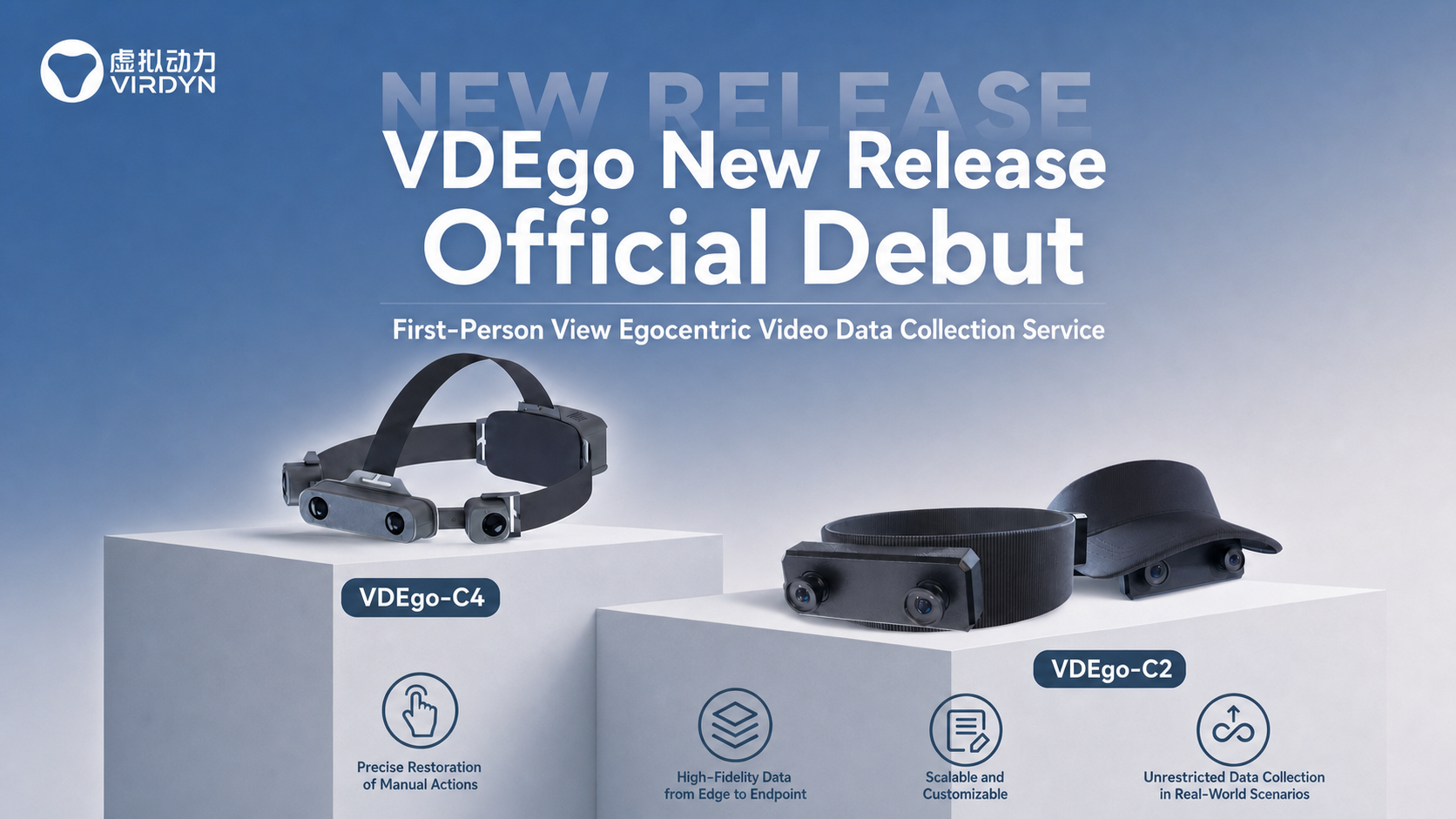
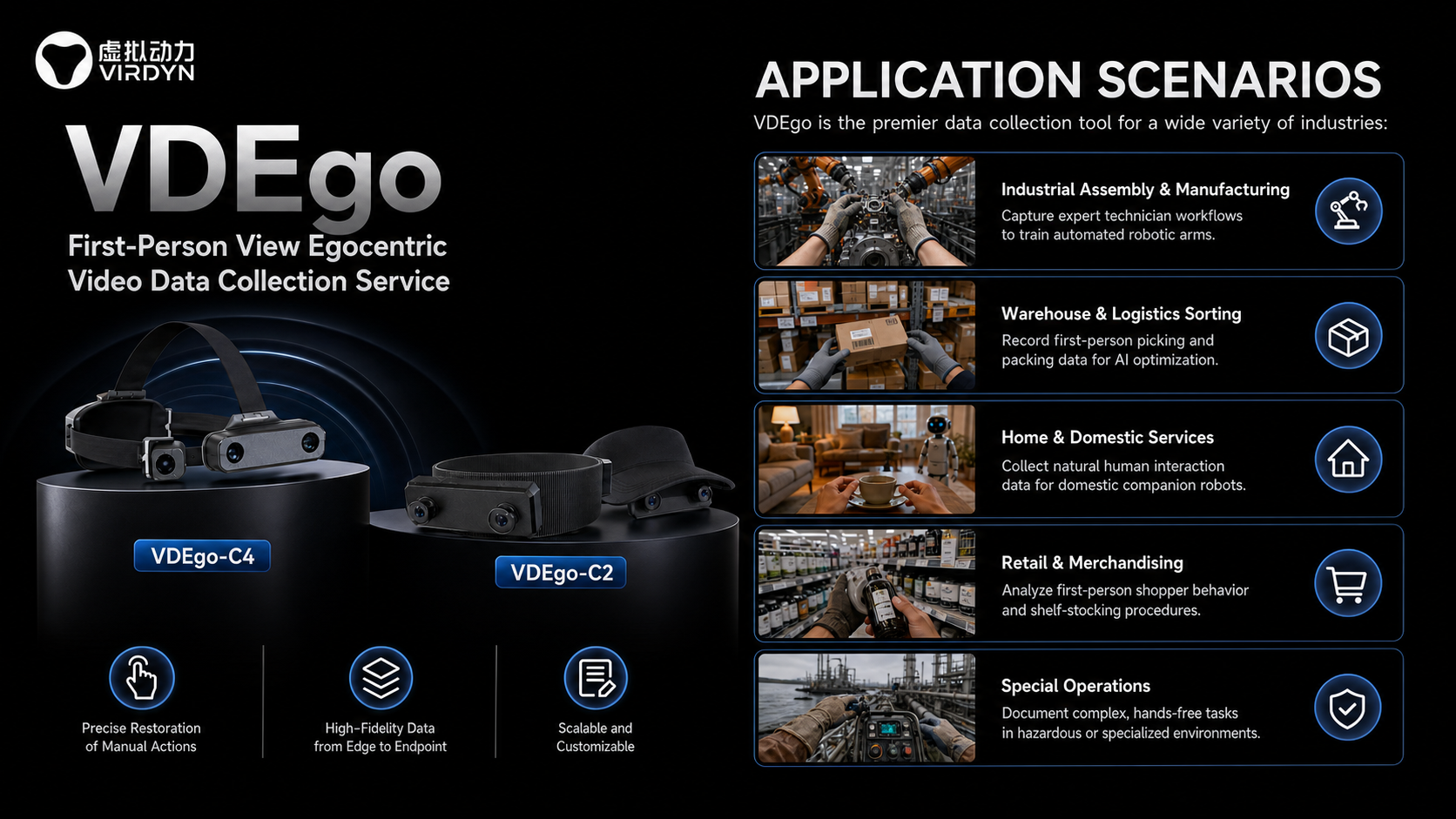
To meet the industry’s demand for high-fidelity, scalable data collection, Virdyn is proud to introduce VDEgo, a state-of-the-art Egocentric Video Data Collection Device.
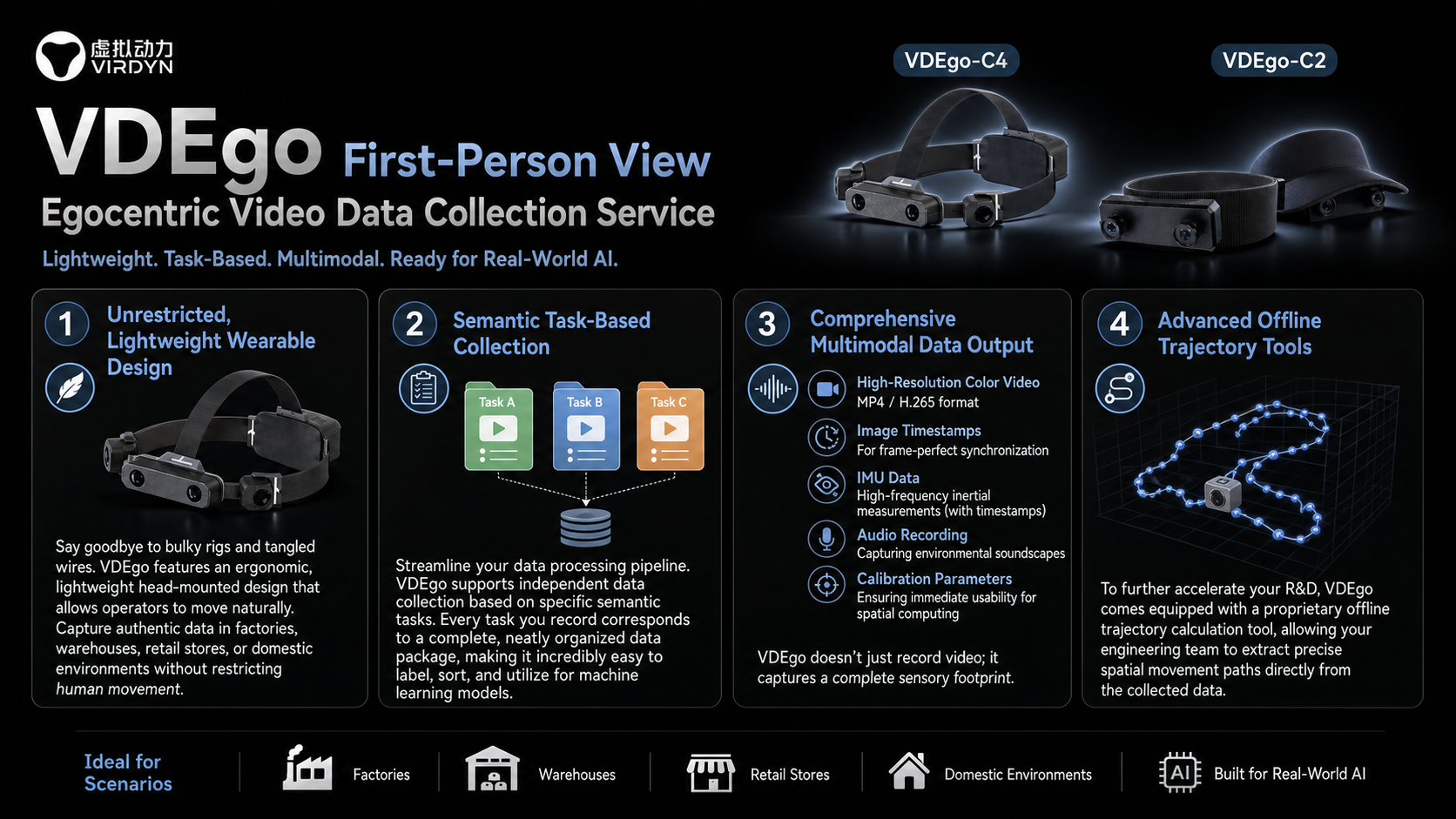
Designed with a lightweight, wearable form factor, VDEgo allows operators to move naturally, enabling unrestricted data collection in real-world scenarios—from busy factory floors to domestic living rooms. VDEgo is available in two powerful configurations:
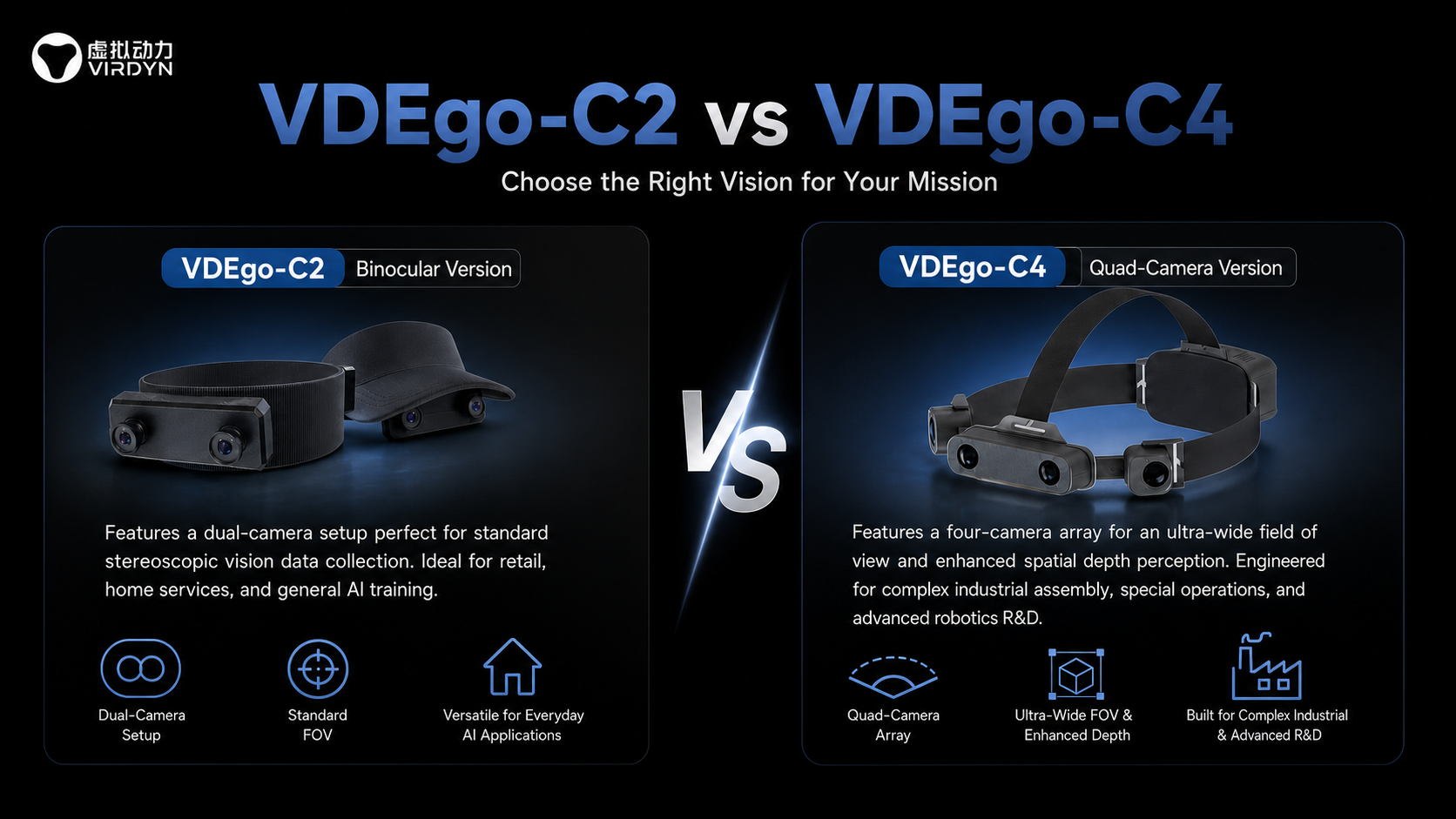
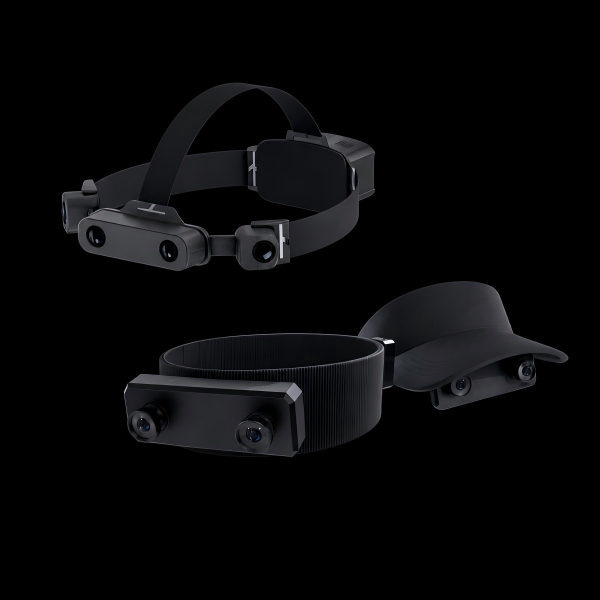
- VDEgo-C2: A binocular (dual-camera) version ideal for standard stereoscopic vision tasks.
- VDEgo-C4: A quad-camera version offering an ultra-wide field of view for complex spatial environments.
Key Features that Set VDEgo Apart:
- Semantic Task-Based Collection: VDEgo supports independent recording based on semantic tasks. This means every specific action you record corresponds to a complete, neatly organized data record, drastically reducing post-processing time.
- Rich Multimodal Output: The device captures everything you need for AI training: Color Video (MP4/H.265), Image Timestamps, IMU Data (with timestamps), Audio, and Calibration Parameters.
- Offline Trajectory Calculation: VDEgo comes with a powerful offline trajectory calculation tool, allowing engineers to easily extract precise movement paths from the raw data.
- Seamless Workflow: Data is securely stored on a local SD card during capture. Operators simply use a one-button physical control on the headset to start and stop recording, ensuring a frictionless experience.
Real-World Application Scenarios
Because of its unrestricted, lightweight design, VDEgo can be deployed at scale across a wide variety of industries:
- Industrial Assembly: Capturing expert technician workflows to train automated robotic arms.
- Warehouse & Logistics Sorting: Recording first-person picking and packing data for AI optimization.
- Home & Domestic Services: Collecting natural human interaction data for domestic companion robots.
- Retail Merchandising: Analyzing first-person shopper behavior and shelf-stocking procedures.
- Special Operations: Documenting complex, hands-free tasks in hazardous or specialized environments.
Conclusion
The future of AI and robotics relies on the quality of the data we feed it. By perfectly synchronizing visual input with physical motion, Virdyn’s VDEgo solves the vision-action disconnect at its source. Whether you are building a localized data factory or conducting cutting-edge academic research, VDEgo provides the scalable, high-fidelity egocentric data you need to push the boundaries of what’s possible.
Ready to scale your data collection? Discover more about the VDEgo-C2 and VDEgo-C4 at Virdyn today.
Post time: Jun-02-2026